

Umbrella Liability Protection: How Extra Coverage Secures Your Net Worth
One lawsuit can wipe out years of financial progress. At H&K Insurance Agency, we see clients every day who think their homeowners or auto policy is enough-until it isn’t.
Umbrella liability protection fills the gap when a major claim exceeds your standard policy limits. It’s the safety net that protects your net worth from catastrophic liability judgments.
What Umbrella Coverage Actually Protects
Your homeowners policy maxes out at $300,000 in liability. Your auto policy covers up to $250,000. Then someone sues you for $2 million after a serious accident on your property, and suddenly those limits look laughably small. Umbrella liability insurance activates after your standard policies are exhausted, covering the gap between what your underlying policies pay and what you actually owe. If that $2 million judgment comes down, your umbrella policy covers the remaining $1.45 million. This isn’t theoretical-major judgments routinely hit $500,000 to $1 million or more.
Legal Defense Costs Add Up Fast
Most people focus on the settlement or judgment amount, but they ignore the legal bills that come before any verdict. Defense attorneys charge $200 to $500 per hour in most markets, and complex liability cases easily run 500 to 1,500 billable hours. That’s $100,000 to $750,000 in legal fees alone. Umbrella policies cover these defense costs in addition to any settlement or judgment.
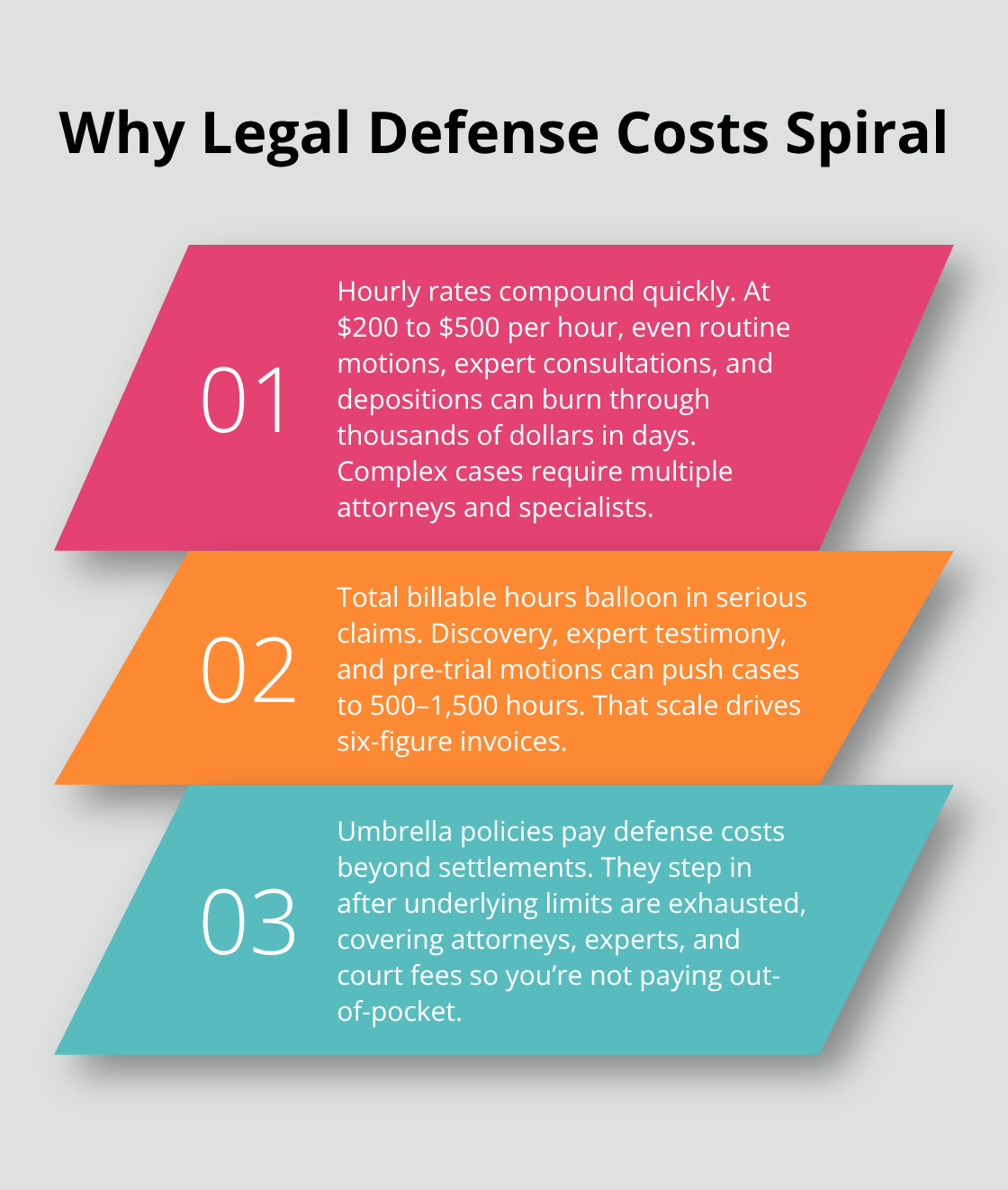
Your homeowners or auto policy might cover defense costs up to your policy limit, but once that limit is reached, the defense costs come straight from your pocket-unless you have umbrella coverage. This means your umbrella policy protects not just the final payout, but also the expensive process of getting there.
Who Gets Sued and Why
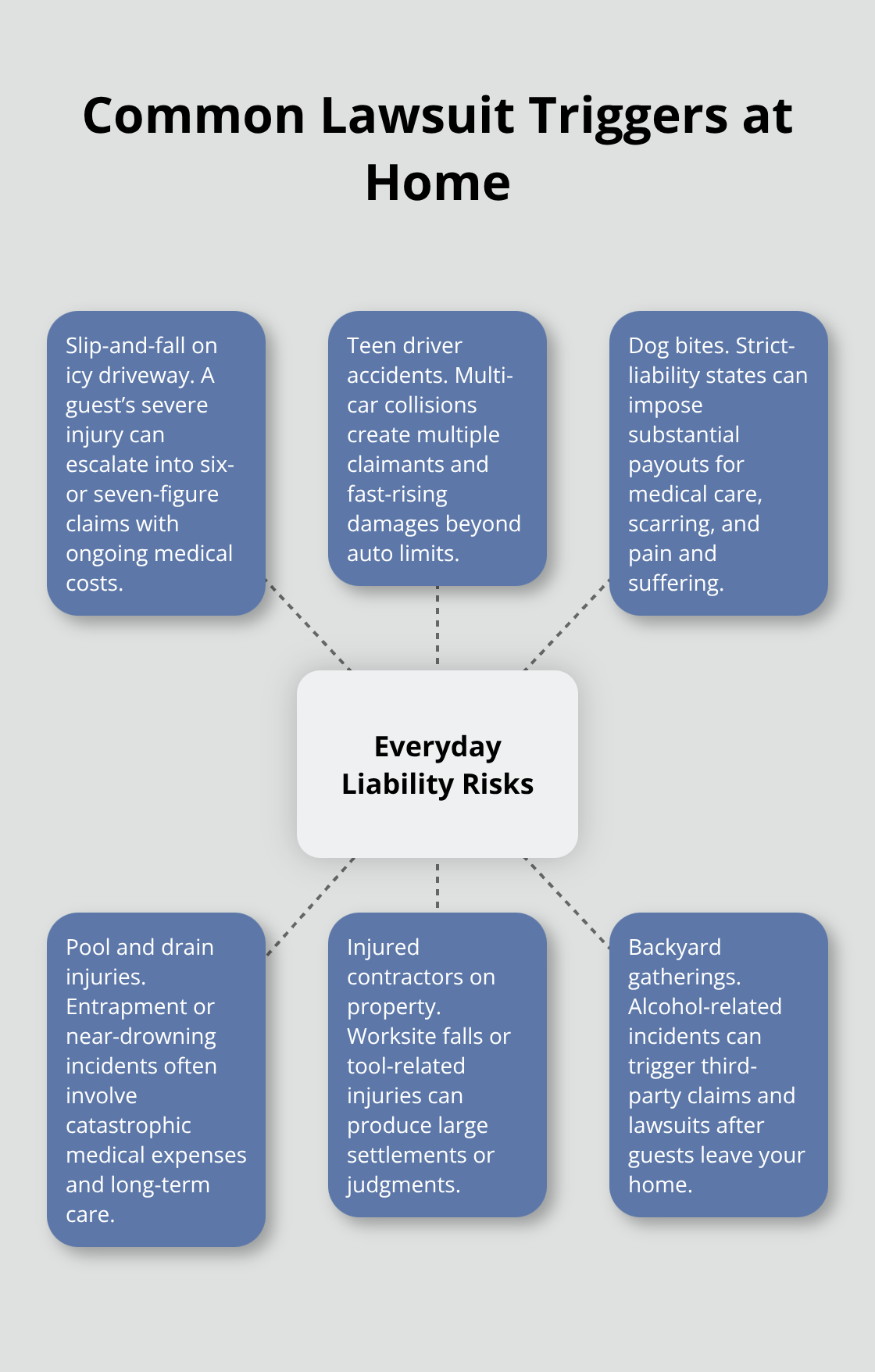
You don’t need to own a business or manage rental properties to face serious liability exposure. A guest slips on your icy driveway and breaks their back. Your teenage driver causes a multi-car accident. Your dog bites a neighbor. Your pool drain injures a visiting child. These aren’t rare scenarios. A homeowner in Portland faced a $1.8 million judgment after a guest was seriously injured at a backyard gathering. Another case in Seattle resulted in a $950,000 settlement when a contractor was injured on residential property. Umbrella insurance covers these exact situations, stepping in when underlying policies run dry and protecting your home, investments, and retirement savings from judgment creditors.
Why Your Current Policies Fall Short
Standard homeowners and auto policies provide baseline protection, but they weren’t designed to handle catastrophic claims. A single serious accident or injury can generate damages that far exceed these limits. Medical expenses, lost wages, pain and suffering, and punitive damages (in some cases) stack up quickly. Courts award damages based on the actual harm caused, not on what your insurance happens to cover. Your underlying policies exhaust their limits, and you face personal liability for everything above that threshold. Umbrella coverage fills this gap, protecting your assets when the unexpected happens.
Who Actually Needs Umbrella Coverage
Umbrella liability insurance isn’t reserved for billionaires or Fortune 500 executives. Anyone with assets worth protecting should have it, and that threshold is lower than most people think. If you own a home, have a car, maintain a savings account, or hold retirement investments, you have something worth defending. A $1 million umbrella policy costs between $150 and $300 annually for most homeowners, yet protects against judgments that could liquidate decades of financial progress.
Your Net Worth Becomes a Lawsuit Target
The moment you own real estate, you become a potential defendant in someone’s injury claim. Property owners face liability exposure from guests, contractors, delivery personnel, and even trespassers who suffer injuries on the premises. Homeowners with pools, trampolines, or frequently visited properties face significantly higher exposure. Business owners-whether running a home-based consulting practice or managing rental properties-encounter additional liability vectors through employee injuries, customer incidents, or contractual disputes.
A single serious accident can generate damages far exceeding your underlying policy limits. Courts don’t care about your insurance limits when calculating damages; they award based on actual harm. Your net worth becomes the enforcement mechanism. If a judgment exceeds your policy limits, creditors can pursue wage garnishment, bank account seizures, and forced asset sales to satisfy the judgment. Umbrella insurance interrupts this process by covering the gap.
Occupations and Activities That Elevate Your Risk
Certain professions and lifestyle choices dramatically increase liability exposure. Landlords face tenant injury claims, property damage disputes, and habitability violations that routinely exceed standard policy limits. Contractors and tradespeople working from home encounter client injury incidents. Parents who regularly host gatherings-whether children’s parties, holiday events, or recreational activities-create injury opportunities on their property.
Drivers with teenage children, those who frequently transport others, or individuals with multiple vehicles face compounded auto liability exposure. Dog owners in states with strict liability laws face significant bite-related claims. Someone hosting a backyard event where a guest consumes alcohol and later causes an accident can face third-party liability claims. These aren’t hypothetical scenarios-they’re the exact situations that generate the multi-hundred-thousand-dollar judgments umbrella policies were designed to cover.
Why Standard Policies Leave You Exposed
Standard homeowners and auto policies provide baseline protection, but they weren’t designed to handle catastrophic claims. Medical expenses, lost wages, pain and suffering, and punitive damages (in some cases) stack up quickly. Your underlying policies exhaust their limits, and you face personal liability for everything above that threshold. The specific risk factors matter less than recognizing that ordinary activities create extraordinary liability exposure, and that recognition should prompt you to evaluate your current coverage limits and determine whether umbrella protection fits your financial situation.
How Much Umbrella Coverage Do You Actually Need
Calculate Your Total Assets and Future Earnings
Start by calculating your total assets, not just your home value. Most people focus on their house and forget about investment accounts, retirement funds, vehicles, and business assets. Add up everything: your home equity, savings accounts, investment portfolios, vehicles, and any business assets. Then add your expected lifetime earnings. A 45-year-old earning $80,000 annually has roughly $1.6 million in future earning potential over the next 20 years. Courts can garnish wages for years to satisfy judgments, so your future income is absolutely part of your liability exposure calculation. If your total assets and earning potential exceed $1 million, you need umbrella coverage that matches or exceeds that number. Most people with $500,000 or more in net worth should carry at least $1 million in umbrella protection.
Evaluate Your Specific Liability Triggers
Rental property owners need significantly more coverage than primary residence owners because they face tenant injury claims, property damage disputes, and code violation liabilities. Someone who hosts frequent gatherings or parties faces higher exposure than someone who rarely entertains. Parents with teenage drivers should account for the elevated risk that comes with young drivers causing serious accidents. If you operate any business from home-even a consulting practice with occasional client visits-your exposure increases substantially.
Determine Coverage Limits Based on Worst-Case Scenarios
We recommend calculating coverage based on worst-case scenarios, not average situations. A $2 million judgment isn’t rare when serious injuries are involved. Medical costs for catastrophic injuries now routinely exceed $1 million, and juries often award substantial pain and suffering damages on top of medical expenses.
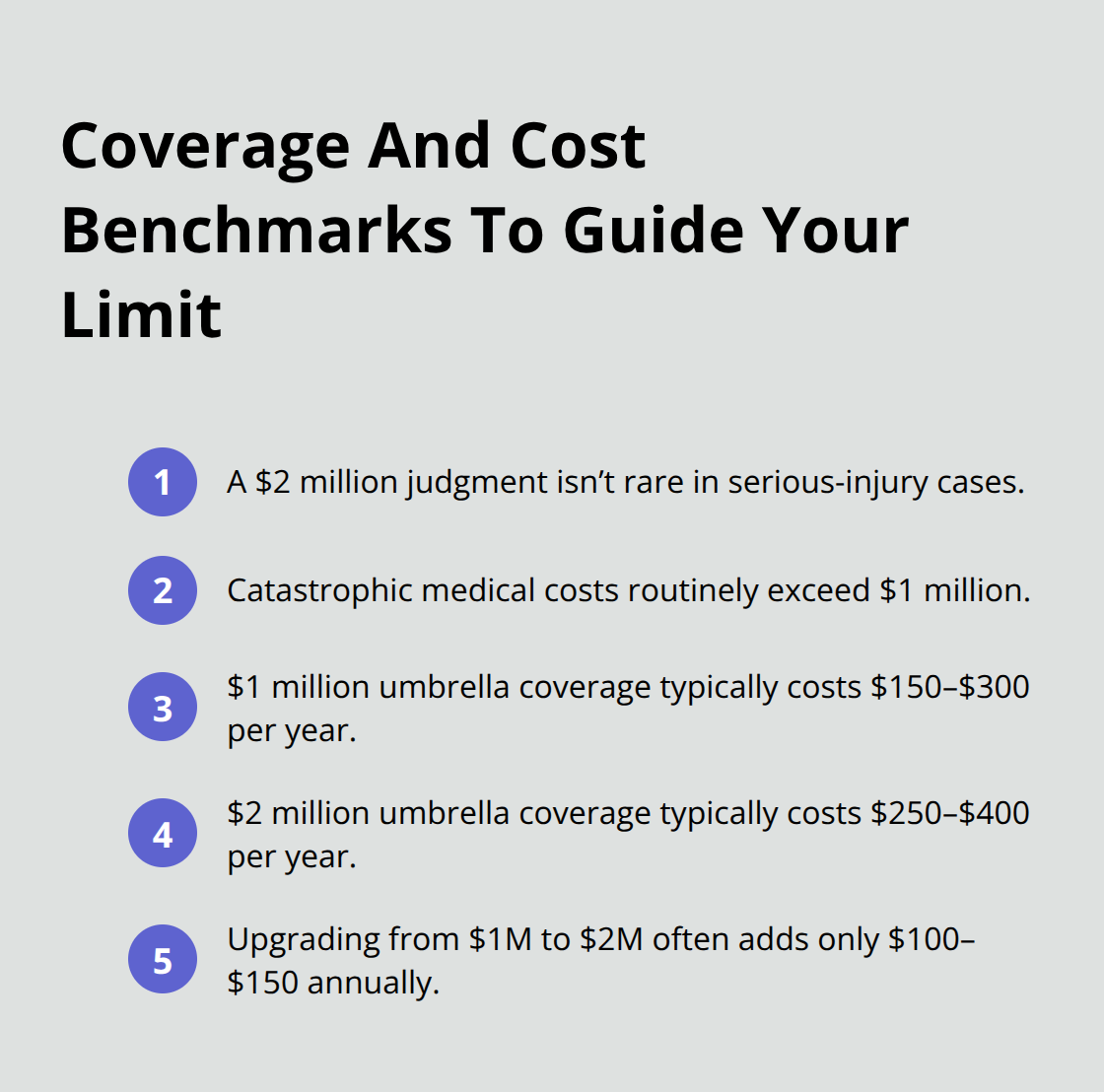
Most umbrella policies start at $1 million coverage for $150 to $300 annually, with $2 million policies running $250 to $400 per year. The cost difference between $1 million and $2 million coverage is often just $100 to $150 annually, making the upgrade financially sensible for anyone with meaningful assets.
Compare Rates Across Multiple Carriers
Shop quotes from multiple carriers because rates vary significantly-some companies charge $180 for $1 million coverage while others charge $320 for identical protection. Coverage terms matter too. Some policies exclude certain activities like business operations or rental properties, while others provide broader protection. Read what your umbrella policy actually covers before purchasing, because gaps in coverage defeat the entire purpose of carrying the protection.
Final Thoughts
Umbrella liability protection costs $150 to $300 annually for $1 million in coverage, yet shields your home, investments, and future earnings from judgments that routinely hit $500,000 to $2 million. Without this coverage, one serious accident or injury claim forces you to liquidate assets, face wage garnishment, or lose property you’ve spent decades acquiring. The financial math makes the decision obvious for anyone with meaningful net worth.
Calculate your total assets including home equity, savings, investments, and retirement accounts, then add your expected lifetime earnings. If that total exceeds $500,000, you need umbrella liability protection that matches or exceeds your net worth. Contact an independent insurance agency that represents multiple carriers, because rates vary dramatically across companies for identical coverage (a policy that costs $250 with one carrier might cost $350 with another).
We at H&K Insurance Agency help northwest residents and military families compare umbrella policies alongside their existing auto and homeowners coverage. Contact H&K Insurance Agency to get quotes on umbrella liability protection today.

