
Puget Sound Umbrella Protection: Extra Liability You Can Trust
Your homeowners and auto insurance policies have limits. When a lawsuit or accident exceeds those limits, your personal assets face real danger.
At H&K Insurance Agency, we see Puget Sound residents and military families underestimate their liability exposure every day. Puget Sound umbrella protection fills the gaps that standard policies leave open, giving you the coverage you actually need.
Why Your Assets Are Vulnerable in the Puget Sound Region
Liability Claims Cost More Than You Think
Liability claims in Washington state are rising faster than most people realize. A single serious accident on your property or a car crash where you’re found at fault can quickly exhaust your standard homeowners or auto policy limits.
Most homeowners policies cap liability at $100,000 to $300,000, and standard auto policies typically max out at $100,000 per incident. In the Puget Sound region, where property values are high and population density creates more interaction points for accidents, these limits often fall dangerously short.
When Standard Coverage Fails
A lawsuit over a drowning incident at your home, a major multi-vehicle accident, or a guest injured on your property can easily exceed $500,000 in damages. When your primary insurance runs out, your savings, house equity, retirement accounts, and future wages become targets for judgment creditors.
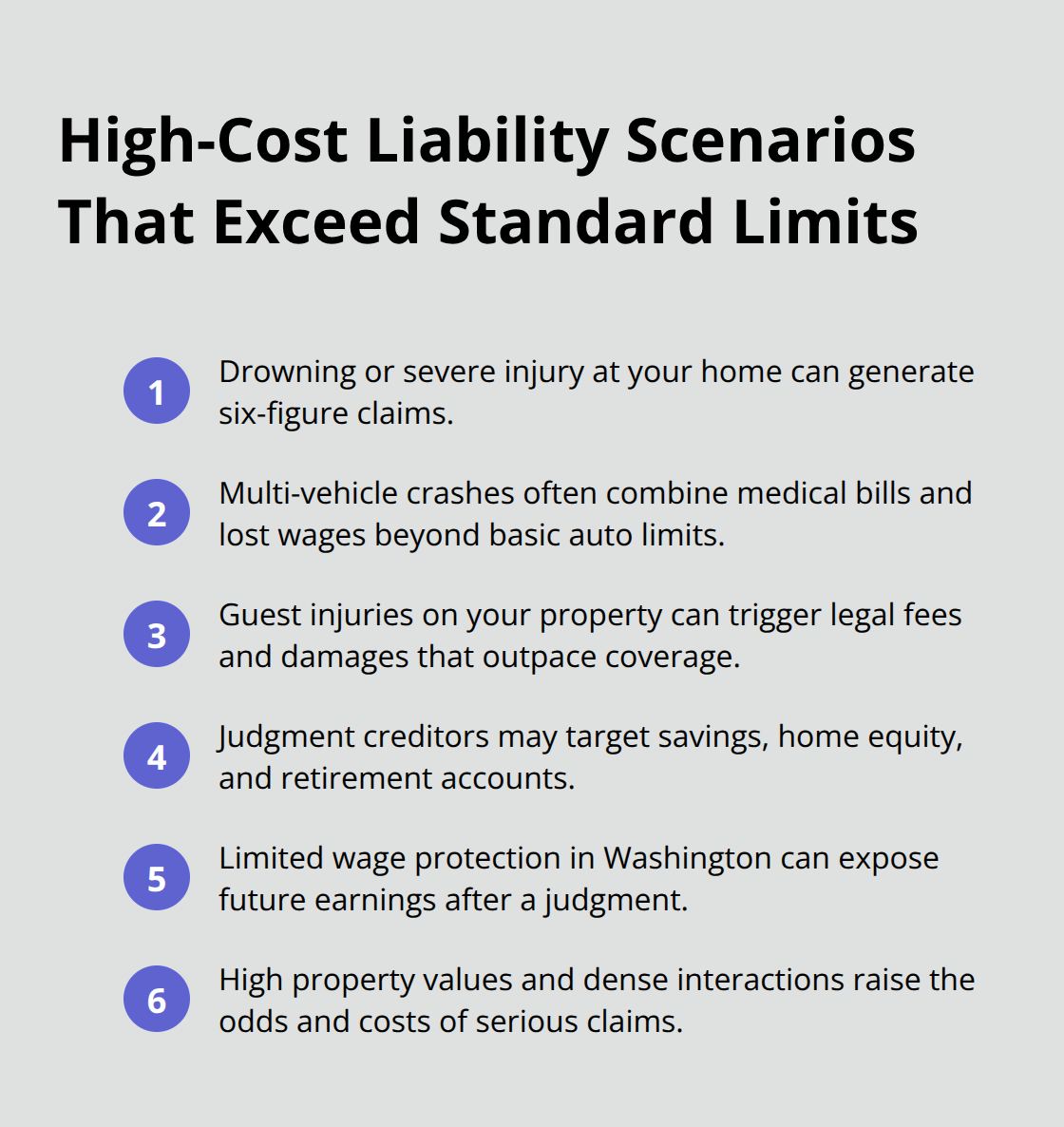
Washington state law allows creditors to pursue your assets aggressively. Unlike some states, Washington offers limited wage protection after a judgment, which means your financial future faces real exposure.
Military Families Face Extra Gaps
Military families stationed in the Puget Sound region face additional exposure because military housing often doesn’t extend liability coverage to family members’ personal activities off base. This gap leaves protection holes that umbrella policies specifically address.
A $1 million umbrella policy costs between $150 and $300 annually for most Puget Sound homeowners, yet protects against claims that could wipe out decades of financial stability. Without this layer of protection, a single catastrophic event doesn’t just affect your current finances-it can derail your retirement plans and limit your ability to help your family’s future.
The Real Cost of Underinsurance
The gap between what your existing policies cover and what a serious liability claim could cost is exactly where umbrella insurance operates. Residents often underestimate how quickly liability exposure grows with home ownership, boat ownership, or multiple vehicles. A catastrophic event creates financial consequences that extend far beyond the immediate year.
Understanding these vulnerabilities is the first step toward real protection. The next section explains exactly how umbrella coverage works alongside your existing policies to fill these dangerous gaps.
How Umbrella Insurance Fills the Protection Gap
Umbrella insurance doesn’t replace your homeowners or auto policy-it sits on top of them and activates only after your primary coverage maxes out. Here’s how the structure works in practice: your homeowners policy covers the first $300,000 of a liability claim, then your umbrella policy picks up the remaining balance up to its limit, typically $1 million or $2 million. This layering approach matters because insurers won’t sell you umbrella coverage unless you maintain minimum underlying limits on your primary policies, usually $300,000 for homeowners and $250,000 to $300,000 for auto. Most Puget Sound residents should carry at least $1 million in umbrella protection, and military families with multiple vehicles or rental properties should seriously consider $2 million given their exposure to lawsuits.
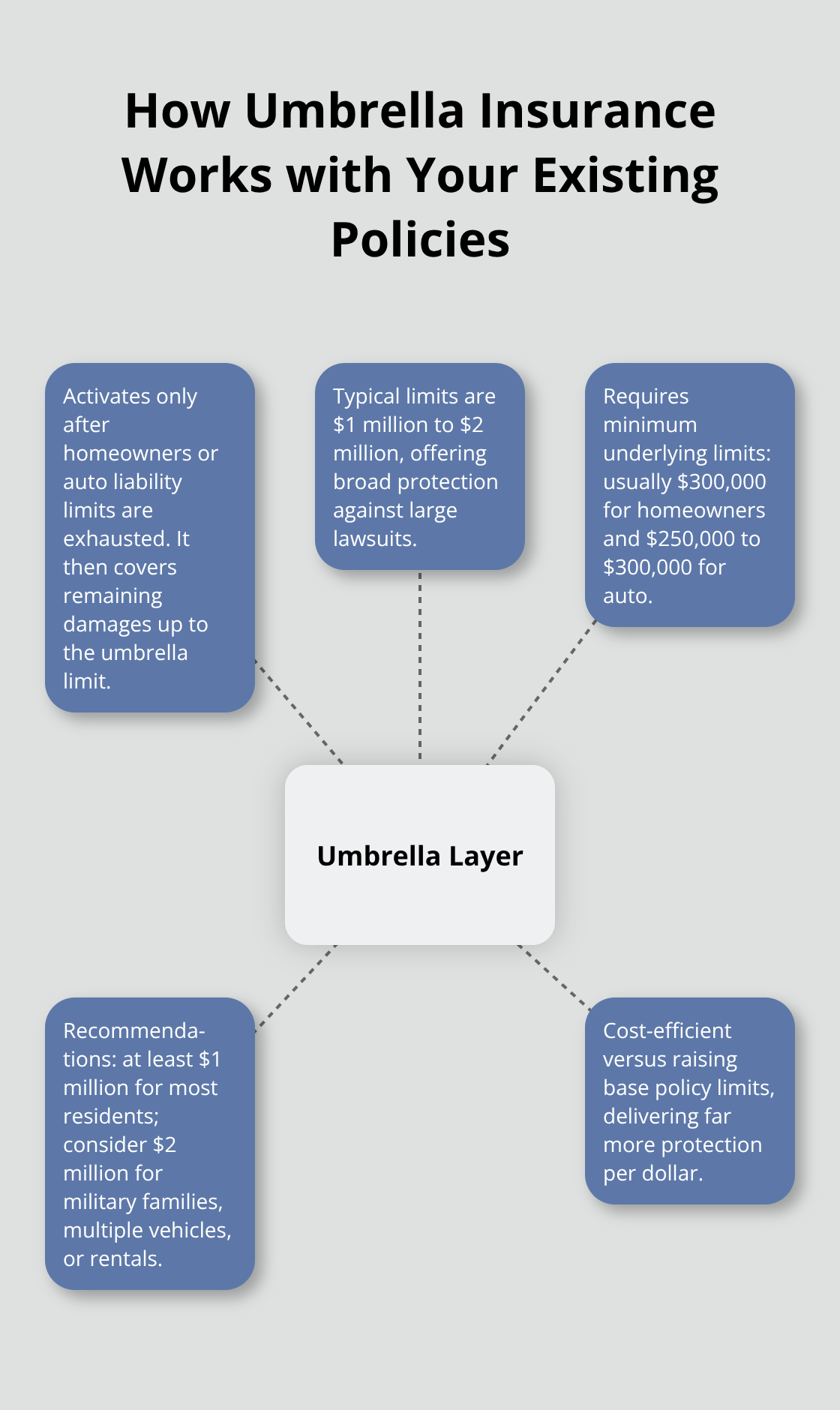
The cost efficiency is remarkable: a $1 million umbrella policy runs $150 to $300 annually, while bumping your homeowners liability from $300,000 to $500,000 costs roughly the same amount but covers far less additional risk.
When Umbrella Coverage Actually Activates
A guest suffers a serious fall on your deck, and medical bills plus pain-and-suffering damages total $750,000. Your homeowners policy pays $300,000, leaving a $450,000 gap that your umbrella policy covers completely. Another scenario: you cause a multi-vehicle accident on Interstate 5 where three people suffer permanent injuries and lost wages exceed $1.2 million. Your auto policy covers $300,000, your umbrella picks up the remaining $900,000. Without that umbrella layer, you’d face a $900,000 judgment against your personal assets. The Insurance Information Institute reports that serious liability claims exceed standard policy limits in roughly 1 in 50 incidents, which sounds rare until you consider that over a 30-year homeownership period, your odds of facing such a claim climb substantially. Washington state’s aggressive asset pursuit laws mean creditors can garnish wages and seize home equity after a judgment, making this protection genuinely essential rather than optional.
Coverage Limits Require Honest Assessment
A $1 million umbrella works fine if you own a modest home and one vehicle, but it falls short if you own rental properties, operate a home business, or own recreational vehicles like boats or RVs. Each rental property multiplies your liability exposure because tenant injuries or guest incidents at rental units create separate liability risks. Puget Sound residents with multiple properties or high-net-worth situations exceeding $1 million in liquid assets should try $2 million umbrella coverage. The additional premium for $2 million versus $1 million coverage averages just $100 to $150 annually, making the upgrade financially sensible for anyone with significant assets to protect. Your underlying policy limits also matter-some insurers won’t write umbrella coverage if your homeowners liability sits below $300,000 or your auto liability below $250,000, so you’ll need to adjust those minimums first if they’re currently lower.
How to Assess Your Specific Exposure
Your liability risk depends on factors unique to your situation. A home-based business that invites clients or customers onto your property creates exposure that standard homeowners policies don’t adequately cover. Rental properties, pools, trampolines, and frequent entertaining all increase the likelihood that someone will suffer an injury on your property and file a claim. Multiple vehicles (especially if household members drive regularly) compound your auto liability exposure. The combination of high Puget Sound property values and Washington’s creditor-friendly judgment laws means that protecting your assets requires honest assessment of what you actually own and what risks you face.
Moving Forward with Your Protection Strategy
Once you understand how umbrella coverage works and what limits fit your situation, the next step involves selecting a policy that aligns with your actual assets and lifestyle. The right umbrella policy doesn’t just cover the gaps in your existing insurance-it provides the peace of mind that comes from knowing a catastrophic event won’t destroy your financial future.
Selecting Coverage That Matches Your Real Assets
Calculate Your Total Exposure Honestly
Choosing an umbrella policy starts with an honest inventory of what you own and what creditors could take if a lawsuit goes against you. Most Puget Sound residents focus only on their home value when calculating protection needs, but that’s incomplete math. You need to account for liquid savings, retirement accounts, investment portfolios, rental property equity, and future earning potential.
If your home is worth $800,000, you have $200,000 in savings, and rental properties valued at $500,000, your total exposure exceeds $1.5 million. A $1 million umbrella policy leaves a $500,000 gap. Washington state creditors can pursue wages for up to ten years after a judgment, which means your future earnings become part of the calculation. Someone earning $100,000 annually has roughly $1 million in vulnerable wages over the next decade.
Add Your Wage Garnishment Risk
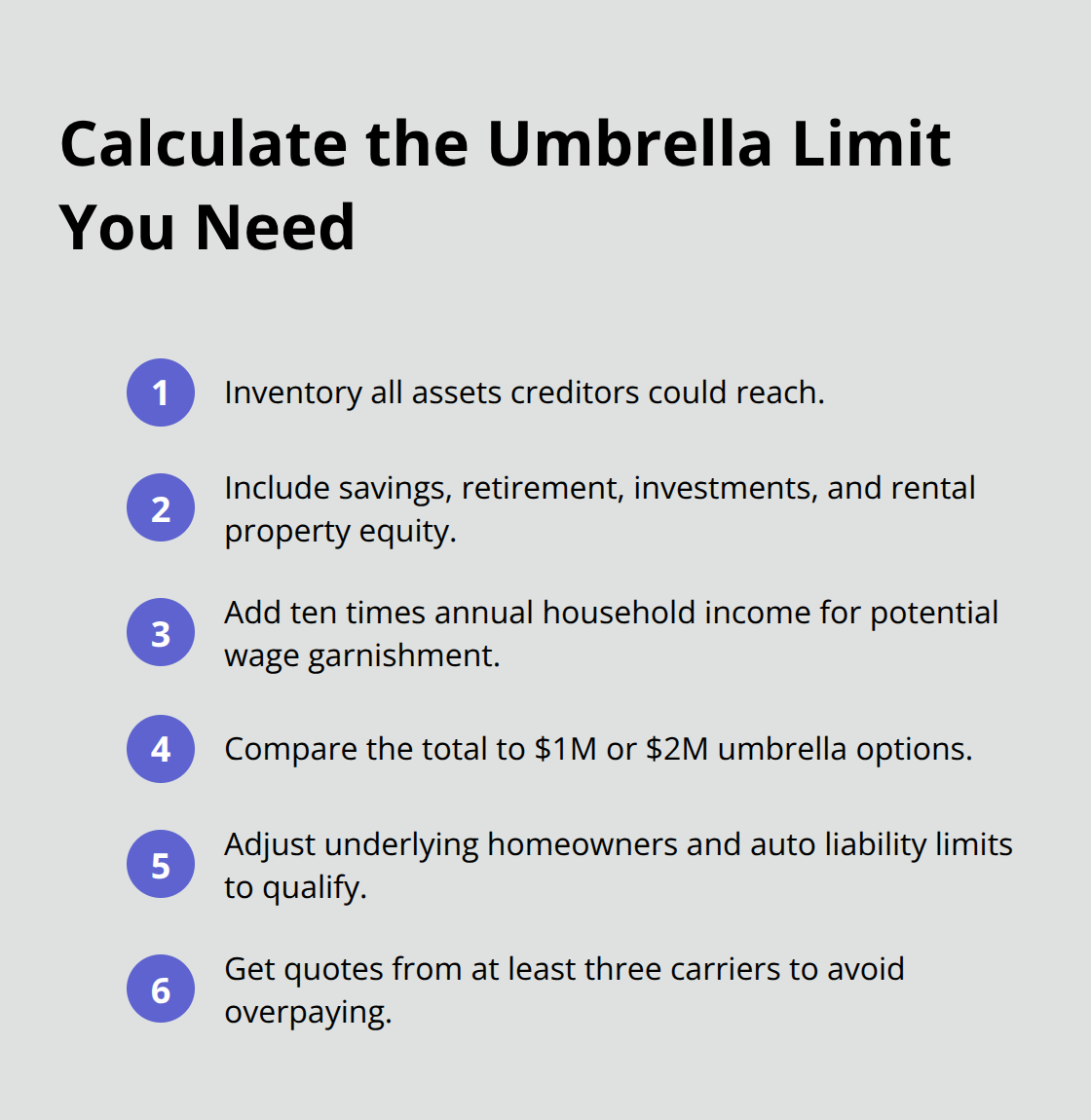
Add your current assets to your future earning potential, and the required umbrella limit becomes clearer. We recommend calculating your total liquid and semi-liquid assets, then adding ten times your annual household income to account for wage garnishment exposure. That total should drive your umbrella limit selection.
A $2 million policy costs only $250 to $400 annually for most Puget Sound homeowners, making it the sensible choice if your total exposure exceeds $1 million. Underestimating your assets to save $100 or $150 annually on premiums is genuinely risky when a single liability event could cost you hundreds of thousands.
Understand What Different Limits Actually Protect
The comparison between coverage options requires understanding what different limit levels actually protect. A $1 million umbrella covers most single-incident claims but fails against catastrophic multi-vehicle accidents or severe injuries with permanent disability awards. The National Safety Council reports that serious injury claims frequently exceed $1 million when permanent disabilities are involved.
If multiple people suffer permanent injuries in an incident you cause, damages accumulate quickly. A $2 million limit handles these scenarios without leaving you exposed. Your underlying policy limits also affect which umbrella options are available to you. Some insurers require $500,000 homeowners liability before writing a $2 million umbrella, while others accept $300,000 limits.
Shop Rates Across Multiple Carriers
Shopping rates across multiple carriers matters because premium differences for identical coverage can exceed $200 annually. Military families stationed locally should discuss their specific exposure with an agent who understands both civilian liability risks and the gaps that military housing policies create. Your home business, rental properties, or vehicles all change which carriers will write your umbrella and at what price.
As a locally owned, independent agency serving the Puget Sound region, we represent multiple top local and national carriers, which means we can compare your options across different companies rather than locking you into one insurer’s pricing. Getting quotes from at least three different carriers (whether through us or independently) ensures you’re not overpaying for coverage you actually need.
Final Thoughts
Puget Sound umbrella protection isn’t a luxury for the wealthy-it’s essential financial defense for anyone with assets worth protecting. A single liability claim can exceed your standard homeowners or auto policy limits within hours, leaving your savings, home equity, and future wages vulnerable to creditors. Military families and Puget Sound residents face particular exposure because of high property values, aggressive Washington state collection laws, and the density of daily interactions that create accident opportunities.
The math is straightforward: a $1 million umbrella policy costs $150 to $300 annually and covers gaps that would otherwise cost you hundreds of thousands, while a $2 million policy runs only $100 to $150 more per year. Calculate your actual exposure by adding your liquid savings, home equity, rental property values, and ten years of potential wages-that total determines whether $1 million or $2 million in umbrella coverage fits your situation. You may also need to adjust your underlying policy limits (most insurers require at least $300,000 homeowners liability and $250,000 auto liability before writing umbrella coverage).
Premiums vary significantly across carriers for identical coverage, so contact H&K Insurance Agency to compare your options and build the insurance strategy that actually protects your financial future.

