

Kitsap Homeowners Coverage: A Personal Guide To Protection
Your home is likely your biggest investment, and protecting it with the right Kitsap homeowners coverage is non-negotiable. Most homeowners underestimate what they actually need to cover, leaving themselves exposed to serious financial risk.
At H&K Insurance Agency, we’ve helped countless Kitsap residents navigate their coverage options and find policies that actually match their lives. This guide walks you through exactly what you need to know to make smart decisions about your protection.
Understanding Your Home’s Value and Kitsap’s Unique Risks
Calculate Your Home’s True Replacement Cost
Your home’s replacement cost differs dramatically from its market value or purchase price. Insurance companies measure only one figure: what it would cost to rebuild your house from the ground up if it burned down tomorrow. In Kitsap County, construction costs vary based on local factors, materials, and labor rates. A 2,000-square-foot home in Bremerton could run $300,000 to $400,000 to rebuild, yet many homeowners carry policies with $250,000 in dwelling coverage and face serious shortfalls after a total loss.
A professional appraisal or the replacement cost calculator from the National Association of Insurance Commissioners establishes an accurate starting point. Your contents demand equal attention. Most people estimate they own around $30,000 to $50,000 in personal property, then insurance adjusters find they actually have $80,000 to $120,000 worth of possessions. Photograph every room, closet, drawer, and garage shelf. Capture serial numbers on electronics, tools, and appliances. Keep receipts for major purchases. This inventory becomes your evidence if you file a claim and prevents you from underinsuring what you actually own.
Address Kitsap’s Specific Environmental Hazards
Kitsap County sits in a zone where specific natural hazards demand specific coverage attention. The region experiences occasional flooding, particularly in areas near streams and low-lying neighborhoods, yet standard homeowners policies exclude flood damage entirely. Flood insurance through the National Flood Insurance Program protects you from catastrophic out-of-pocket losses during heavy rain events.
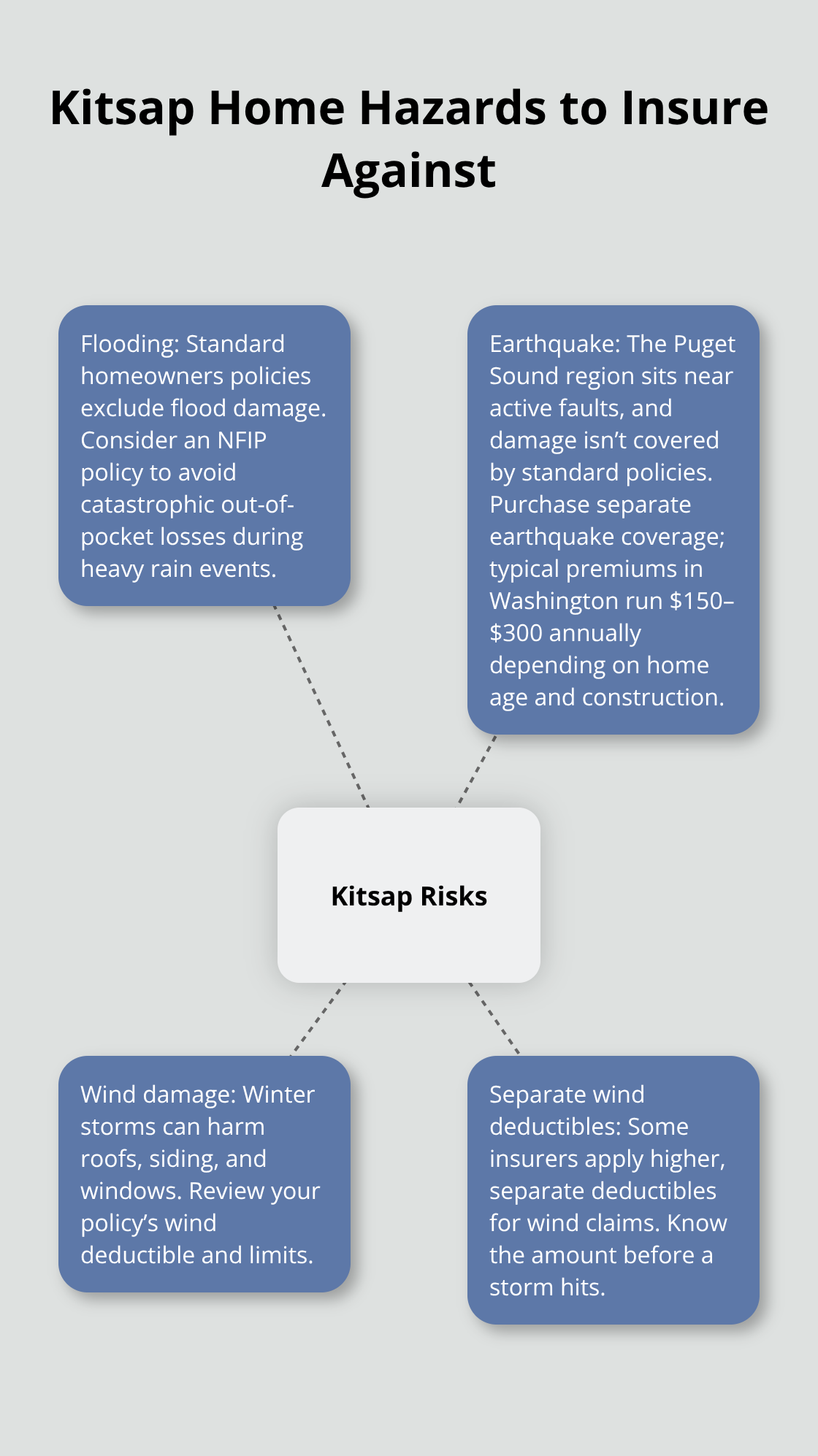
Earthquake coverage ranks equally important. The Puget Sound region sits near active fault lines, and seismic activity poses genuine risk to home structures. Standard policies do not cover earthquake damage, so you must purchase it separately. Homeowners in Washington typically pay $150 to $300 annually for earthquake coverage depending on home age and construction type. Wind damage, while less common than in coastal regions, still occurs during winter storms and can damage roofs, siding, and windows. Review your policy’s wind deductible carefully, as some insurers apply separate, higher deductibles for wind claims.
Set Liability Limits That Match Your Actual Exposure
Setting liability coverage limits requires honest thinking about your actual risk. If someone slips on your icy driveway in February and suffers a serious injury, medical bills and legal judgments could easily exceed $100,000. Standard policies offer $100,000 to $300,000 in liability coverage, but for most Kitsap homeowners, $300,000 represents a bare minimum, not an ideal limit. If you have significant assets, hire a lawyer, or frequently host gatherings, $500,000 to $1,000,000 in liability coverage makes financial sense. The cost difference between $300,000 and $500,000 in liability coverage runs just $15 to $30 annually, making it an obvious upgrade.
Medical payments coverage, separate from liability, pays immediate medical expenses for guests injured on your property regardless of fault, typically ranging from $1,000 to $5,000. Try setting this at $5,000 minimum because it prevents small injuries from turning into lawsuits. Your dwelling coverage should sit at 100 percent of replacement cost, never 80 percent or less. Underinsured dwellings trigger coinsurance penalties where the insurance company pays far less than you expect, leaving you to absorb the difference.
Now that you understand what coverage amounts protect your home and possessions, the next step involves finding policies that actually deliver these protections at prices that fit your budget.
Coverage Types and What They Protect
Dwelling Coverage Protects Your Home’s Structure
Dwelling coverage forms the foundation of your homeowners policy and covers only your home’s structure, not the land it sits on. This includes the walls, roof, flooring, built-in cabinets, and permanent fixtures like your deck or patio. In Kitsap County, construction costs run $150 to $200 per square foot according to local builder estimates, so a total loss can quickly drain your finances if you carry inadequate dwelling limits.
Most homeowners base dwelling coverage on their mortgage balance or purchase price rather than actual replacement cost. Your lender requires coverage, but lenders care about their investment, not your complete protection. If your home cost $350,000 fifteen years ago and you still carry $350,000 in dwelling coverage, you’re likely underinsured by $100,000 or more due to inflation and rising construction costs.
Dwelling coverage also extends to detached structures like garages, sheds, and workshops, though typically limited to 10 percent of your dwelling limit. Kitsap homeowners with separate garages or substantial outbuildings should verify these limits match their actual need.
Personal Property Coverage Protects Your Belongings
Personal property coverage protects your belongings inside the home and covers items like furniture, electronics, clothing, and kitchen appliances. Standard policies cover 50 to 70 percent of your dwelling limit in personal property, meaning a $400,000 dwelling limit includes $200,000 to $280,000 in contents coverage.
The problem surfaces immediately for anyone with expensive collections, high-end electronics, or significant jewelry. A single laptop might cost $2,000, a camera setup $5,000, and jewelry another $10,000, yet many Kitsap homeowners carry only $30,000 to $40,000 in total contents coverage. Scheduled personal property endorsements allow you to add extra coverage to insure high-value items beyond the limits imposed by a standard homeowners policy. Without scheduling, insurance companies apply depreciation, meaning your five-year-old television worth $1,200 when new might only pay out $400.
Liability Coverage Protects You from Legal Claims
Liability coverage protects you when someone suffers injury or property damage on your property and holds you legally responsible. If a guest slips on your stairs and breaks their leg, or if a tree branch from your yard damages a neighbor’s fence, liability coverage pays medical bills, repair costs, and legal judgments up to your policy limit.
Most Kitsap homeowners should carry at least $300,000 in liability coverage, with $500,000 to $1,000,000 preferred for those with significant assets or who frequently host gatherings. The annual cost difference between these limits typically runs $20 to $50, making higher limits an obvious financial decision.
Medical payments coverage, separate from liability, pays immediate medical expenses for guests injured on your property regardless of fault, typically ranging from $1,000 to $5,000. Try setting this at $5,000 minimum because it prevents small injuries from turning into lawsuits.
Now that you understand what each coverage type protects, the next step involves comparing actual policies and finding the rates that fit your budget while delivering complete protection.
Finding the Right Policy Without Overpaying
Compare Quotes Across Multiple Insurers
Fewer than one in four homeowners request multiple quotes, yet this single step saves more money than any other action you can take. Insurance companies price identical coverage differently based on their underwriting models, claims history in your area, and how they weight specific risk factors. One insurer might charge $1,200 annually for your home while another charges $950 for the exact same dwelling limit, personal property coverage, and liability protection.

Over ten years, that difference totals $2,500 in unnecessary expenses.
Gather quotes from at least three major carriers and request identical coverage limits across all quotes so you can make true apples-to-apples comparisons. Most insurers offer online quote tools that take fifteen minutes, though phone conversations with agents often reveal discounts the automated systems miss. As an independent agency representing multiple top local and national carriers, H&K Insurance Agency compares rates across different companies simultaneously, saving Kitsap homeowners the time of contacting five separate insurers individually.
Stack Discounts to Lower Your Premium
Bundling your homeowners policy with auto, boat, or RV coverage can help reduce your total insurance costs. If you currently carry auto insurance with one company and homeowners with another, consolidating to a single insurer often reduces your annual premium by $300 to $600 combined. Don’t assume your current auto insurer offers competitive homeowners rates though-bundle quotes deserve the same comparison treatment as standalone policies.
Beyond bundling, Kitsap homeowners qualify for numerous specific discounts that insurers rarely advertise prominently. Installing deadbolt locks, smoke detectors, and security systems can reduce your premium by 5 to 15 percent. Homeowners aged fifty-five and older frequently receive senior discounts ranging from 5 to 10 percent. Military families stationed in the region often access military-specific discounts through certain carriers.
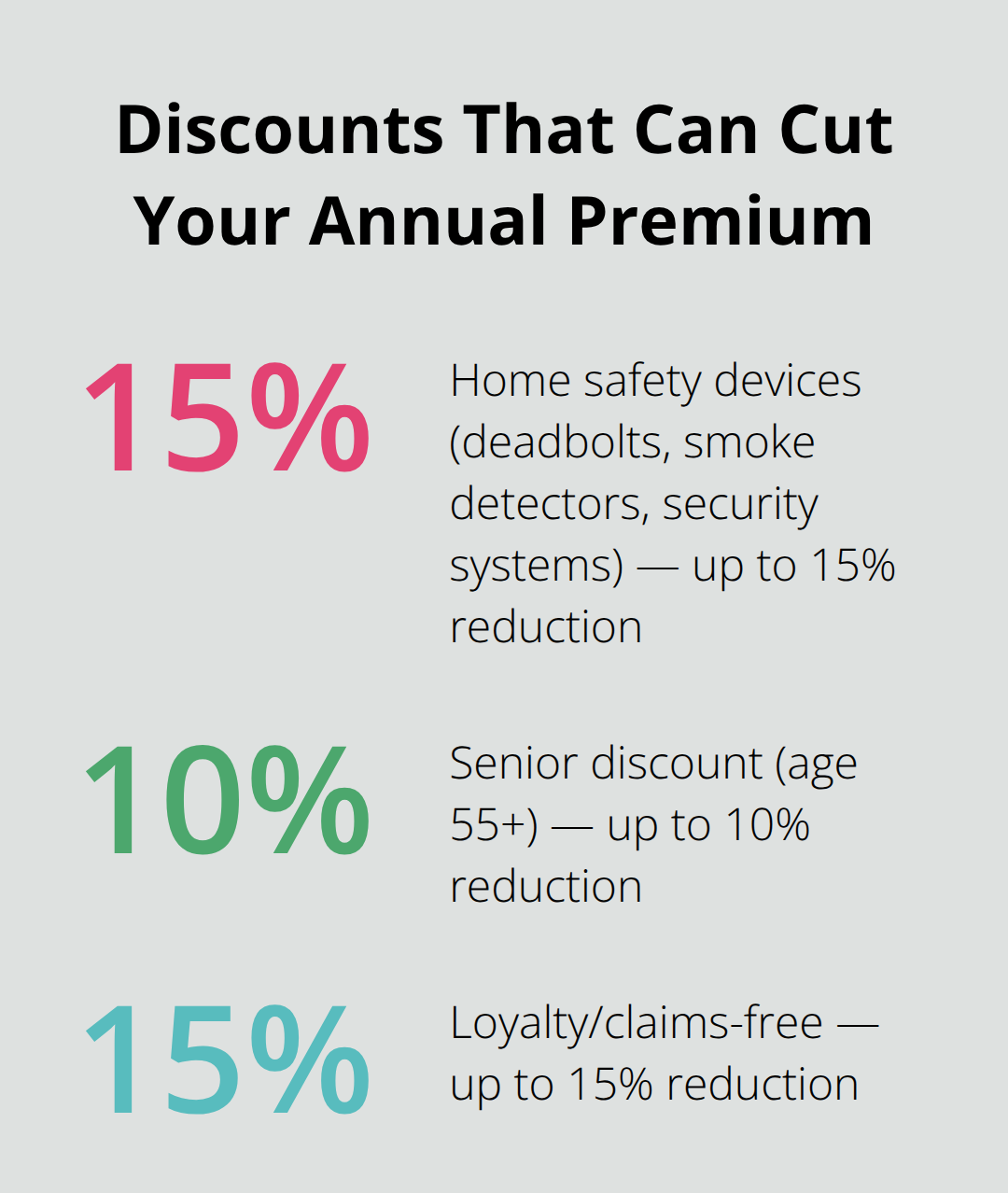
If you’ve maintained a clean claims history for five or more years, loyalty discounts typically run 10 to 15 percent. Paperless billing and automatic payment setup often trigger an additional 2 to 5 percent reduction.
Maximize Your Savings Through Strategic Choices
The cumulative effect of stacking multiple discounts can lower your annual premium by $400 to $800, yet most homeowners claim only one or two available discounts. Ask your agent about every discount your household qualifies for-senior status, military affiliation, professional memberships, and safety features all matter. Some insurers offer discounts for completing online safety courses or installing smart home devices that monitor water usage and detect leaks (reducing water damage claims). Try requesting a complete discount audit from any agent you contact, as this reveals savings opportunities you might otherwise miss.
Final Thoughts
Protecting your Kitsap homeowners coverage requires three concrete actions: calculate your actual replacement cost, understand what each coverage type protects, and compare rates across multiple insurers. Most homeowners skip at least one of these steps and pay the price through underinsurance or overpaying for identical coverage. Your dwelling limit should match 100 percent of reconstruction costs, your personal property coverage should account for everything you actually own, and your liability limits should reflect your assets and lifestyle.
The gap between adequate Kitsap homeowners coverage and inadequate coverage often costs nothing in monthly premiums but everything in claims. A homeowner who carries $250,000 in dwelling coverage on a home requiring $400,000 to rebuild faces a $150,000 shortfall after total loss. That same homeowner could have added $150,000 in coverage for perhaps $30 to $50 annually-the math is brutal and preventable.
Your next step involves requesting quotes from at least three different insurers using identical coverage limits, then asking about every discount your household qualifies for. Bundling policies, installing security systems, maintaining a clean claims history, and choosing automatic payment can reduce your annual premium by $400 to $800. Contact H&K Insurance Agency to compare rates across multiple carriers and customize packages that address Kitsap’s specific environmental risks.
