

Kitsap Homeowners Coverage: Practical Tips For Local Home Protection
Kitsap homeowners face unique insurance challenges that standard policies often overlook. From heavy rainfall to seismic activity, our region demands coverage tailored to local conditions.
We at H&K Insurance Agency help homeowners understand what protection they actually need. This guide walks you through essential coverage types, cost-saving strategies, and how to strengthen your policy against Kitsap’s specific risks.
What Standard Policies Miss in Kitsap County
Flood and Earthquake Coverage Gaps
Standard homeowners insurance in Washington covers fire, theft, windstorm, and hail damage, but it explicitly excludes two major threats facing Kitsap County: flooding and earthquakes. The Insurance Information Institute confirms that flood coverage requires a separate National Flood Insurance Program policy through FEMA, yet many homeowners skip this step because they assume standard policies protect them. Wind and hail alone account for 39.4% of Washington homeowners claims, which means your roof takes a beating regularly, but water damage from groundwater or bodies of water leaves you completely exposed without additional coverage. Earthquakes pose an even greater risk in our region-the Puget Sound is a seismically active area with hundreds of earthquakes occurring each year, yet standard policies don’t cover earthquake damage at all.
Local Geography Compounds Your Risk
Kitsap’s geography creates multiple exposure points that standard policies ignore. Our proximity to Puget Sound increases tsunami risk, our heavy rainfall creates drainage and water intrusion problems, and our aging infrastructure means older homes face higher water damage exposure. Additionally, water backup from sewer systems or sump pump failures affects roughly 10% of homeowners annually according to industry data, yet this coverage remains optional and often excluded from base policies. These aren’t theoretical concerns-they’re real threats that strike Kitsap homes every year.
Water Damage: Your Biggest Exposure
Freezing and water damage constitute approximately 23.5% of Washington claims, making pipe protection critical during our cold winters. Many homeowners fail to insulate exterior pipes or install frost-free hose bibs, leaving themselves vulnerable to burst pipes that can cost $5,000 to $25,000 in repairs. Electrical fires and unattended cooking account for roughly 54.8% of home fires combined, per the National Fire Protection Association, which means fire safety infrastructure directly impacts your premiums and your family’s safety.
The Personal Property Problem
Personal property coverage should equal 50–70% of your dwelling limit according to the Insurance Information Institute, yet most homeowners underestimate their belongings’ replacement value. If your home floods, earthquake damage occurs, or a major system fails, you’ll face the reality that your policy simply doesn’t cover it. The solution isn’t to accept these gaps-it’s to add targeted endorsements before disaster strikes.
Closing the Coverage Gaps
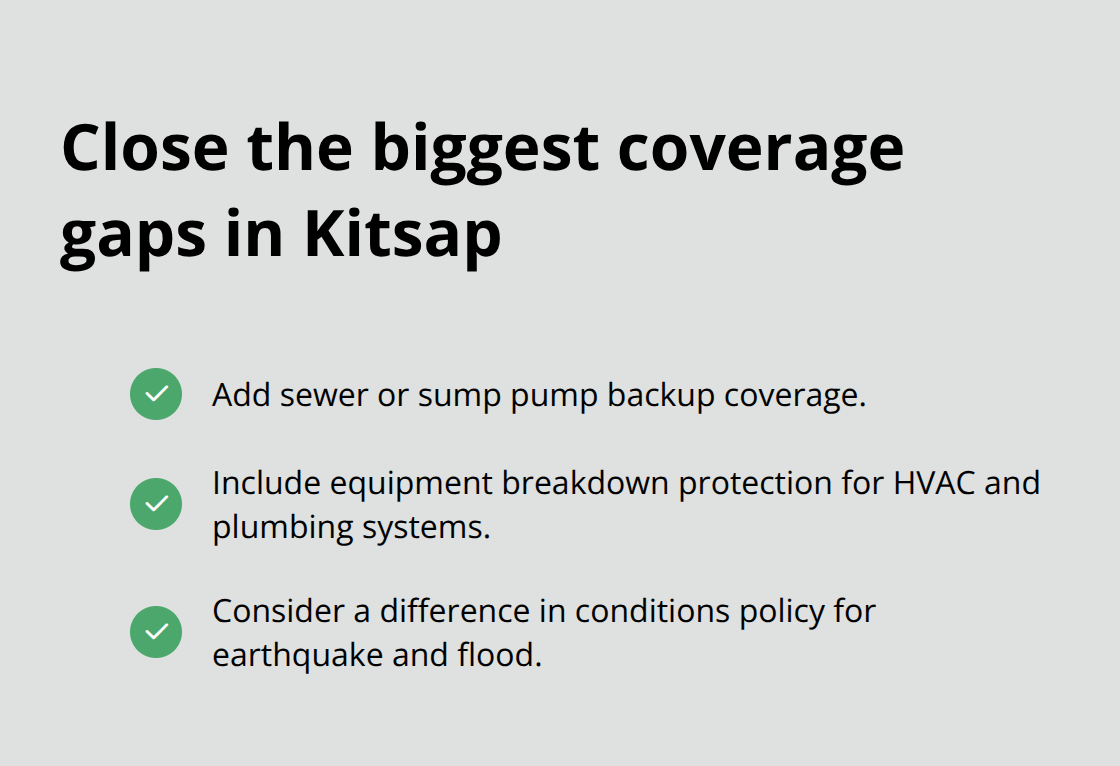
Sewer backup coverage, equipment breakdown protection for HVAC and plumbing systems, and difference in conditions policies that cover earthquakes and floods are all available and affordable when added proactively. H&K Insurance Agency helps Kitsap homeowners identify these gaps and customize their policies with the right endorsements. Understanding what your current policy excludes is the first step toward real protection.
Building the Right Coverage for Your Kitsap Home
Dwelling Coverage: Replacement Cost vs. Actual Cash Value
Dwelling coverage forms the foundation of any homeowners policy, but the way it’s calculated makes a massive difference in what you’ll actually receive after a loss. Replacement cost coverage pays what it costs to rebuild your home today using current materials and labor rates, while actual cash value subtracts depreciation from that amount. The Insurance Information Institute emphasizes this distinction because a home damaged in 2026 costs far more to rebuild than it did five years ago. If your policy uses actual cash value and your roof sustains damage, you might receive $15,000 when replacement actually costs $28,000. This gap forces many homeowners to cover reconstruction costs from savings or loans. Kitsap’s construction costs have climbed steadily, making replacement cost coverage non-negotiable for anyone with a mortgage or significant home equity. Start by reviewing your existing policy documents to identify what your current dwelling coverage actually covers.
Personal Property and High-Value Items
Personal property coverage protects your belongings inside the home, but most policies limit this to 50–70% of your dwelling coverage amount according to the Insurance Information Institute. A $400,000 home typically means $200,000–$280,000 in personal property coverage, which sounds adequate until you inventory your actual possessions. Electronics, furniture, clothing, kitchen equipment, and tools accumulate far faster than most people realize. Create a detailed home inventory with photos and replacement values, storing it securely in the cloud or a fireproof safe. Items like jewelry, artwork, and collectibles hit sub-limits on standard policies, meaning a $5,000 engagement ring might only recover $1,500 without a scheduled personal property endorsement. Adding scheduled endorsements for high-value items costs $50–$150 annually but protects thousands in assets.
Liability and Additional Living Expenses
Liability coverage protects you when someone gets injured on your property or you cause damage to someone else’s home. Most standard policies include $100,000 in liability protection, which sounds substantial until you consider that a serious injury lawsuit can exceed $500,000 easily. The Insurance Information Institute recommends starting at $300,000 in liability coverage, with consideration for a $1–2 million umbrella policy if you have substantial assets or higher-risk exposures. Homeowners with pools, trampolines, or frequent guests face elevated liability risk that justifies umbrella coverage. Additional living expenses coverage typically covers 20–30% of your dwelling limit and pays for temporary housing, meals, and transportation if your home becomes uninhabitable during repairs. After a major fire or earthquake, this coverage prevents financial collapse while reconstruction happens. Loss of use claims process quickly when documented properly, so notify your insurer immediately if you need temporary housing.
Earthquake and Flood Protection for Kitsap Homes
Flood and earthquake coverage remain separate purchases that most Kitsap homeowners delay or skip entirely, despite living in one of the Pacific Northwest’s highest-risk zones. Standalone earthquake insurance typically costs $200–$400 annually and covers structural damage, personal property, and additional living expenses that standard policies exclude. The Puget Sound experiences hundreds of earthquakes yearly, with the 2001 Nisqually quake demonstrating that major seismic events strike this region regularly. Flood insurance through the National Flood Insurance Program costs $400–$800 annually for standard coverage and protects against groundwater intrusion, heavy rainfall flooding, and overflow from nearby bodies of water. If your property sits near drainage areas or in a flood zone according to FEMA flood maps, purchasing flood coverage before water damage occurs saves tens of thousands in uninsured losses. These targeted policies work alongside your standard homeowners coverage to address the specific threats Kitsap County faces, transforming your protection from incomplete to comprehensive.
Cutting Your Premiums Without Losing Coverage
Lowering your homeowners insurance premium without gutting your protection comes down to three concrete strategies: bundling policies, making your home physically harder to damage, and structuring your deductible around your actual financial capacity. Most Kitsap homeowners leave hundreds of dollars annually on the table by treating these decisions as afterthoughts rather than deliberate choices. The National Association of Insurance Commissioners confirms that bundling homeowners and auto policies typically saves 15–25% on combined premiums, yet many people never ask their current insurer what discount they’re actually receiving. If you pay $1,400 annually for homeowners coverage and carry auto insurance elsewhere, bundling could save $210–$350 per year on your homeowners policy alone.
Bundle Home and Auto Policies for Immediate Savings
Contact your existing agent and ask the specific dollar amount saved through bundling. Some insurers quote bundled discounts that evaporate once you add flood or earthquake coverage, so verify the discount applies to your complete policy. Since H&K Insurance Agency represents multiple top local and national carriers, they compare bundled rates across providers, ensuring you get the actual best price rather than marketing promises. Before switching insurers just for a bundled rate, confirm the discount survives when you add specialized coverage that Kitsap homes need.
Install Security Upgrades That Reduce Risk
Home security improvements directly impact your premium because insurers reduce risk when you reduce theft and fire exposure. Installing monitored alarm systems, smoke detectors, carbon monoxide detectors, and smart locks can each trigger separate discounts. A $15,000 home security system costs far more than the discount it generates, but affordable upgrades like motion-detection floodlights, door security bars, and deadbolts on all exterior doors cost under $300 combined while qualifying for discounts worth $150–$300 annually. High-quality locks and sturdy entry-point hardware specifically deter break-ins and signal to insurers that you take protection seriously. Test your smoke and carbon monoxide detectors monthly and document this maintenance, as some insurers require proof that safety devices function properly to maintain discount eligibility.
Structure Your Deductible Around Your Emergency Fund
Your deductible represents the out-of-pocket amount you pay before insurance coverage kicks in, and most homeowners choose $500 or $1,000 without considering how this decision affects their long-term costs. Raising your deductible from $1,000 to $2,500 typically reduces your annual premium by $150–$300, which means you break even financially after five years if you never file a claim. The Insurance Information Institute recommends aligning your deductible with your emergency fund capacity rather than choosing the lowest deductible available. If you have $3,000 in accessible savings, a $1,000 deductible makes sense because you can cover it without financial hardship. Filing claims under $1,000 actually harms your long-term costs because insurers track claims history and raise premiums after multiple small claims, even if they approve them. Avoiding a $400 claim to preserve your claims history often saves more money than the claim itself would provide.
Review Your Policy Annually to Catch Rate Increases
Annual policy reviews catch premium increases before they become permanent and expose better rates that newer competitors offer. Insurance companies raise rates regularly, and many homeowners simply accept these increases without shopping competitors. Contacting three insurers annually for quotes takes two hours and often reveals savings of $200–$500 per year. Your home’s replacement cost changes yearly as construction prices shift, which means your dwelling coverage limit may need adjustment to maintain adequate protection. If you’ve completed renovations, added outbuildings, or significantly improved your home, notify your insurer immediately because these changes increase your home’s replacement cost and may qualify you for coverage adjustments that actually lower premiums per dollar of protection received.
Final Thoughts
Kitsap homeowners coverage requires more than accepting whatever your lender mandates. The gaps in standard policies, the region’s specific earthquake and flood risks, and the cost of rebuilding in today’s market demand intentional decisions about what protection you actually need. Your home represents your largest financial asset, and the coverage you choose determines whether a disaster becomes manageable or financially devastating.
Start by pulling your current policy and identifying what it excludes. Check whether you have replacement cost or actual cash value coverage on your dwelling, verify your personal property limits match your actual belongings, and confirm you’re not relying on standard coverage for flood or earthquake protection. Create a detailed home inventory with photos and replacement values, then compare that total against your policy limits-most Kitsap homeowners discover significant gaps during this review, which is exactly the point.
Contact your insurer about bundling opportunities and security discounts you might be missing. Install affordable security upgrades like motion-detection lights and quality deadbolts, then confirm your insurer applies the corresponding discounts. Reach out to H&K Insurance Agency to review your current coverage, explore bundling options, and build a policy that protects your home against the threats you actually face.

